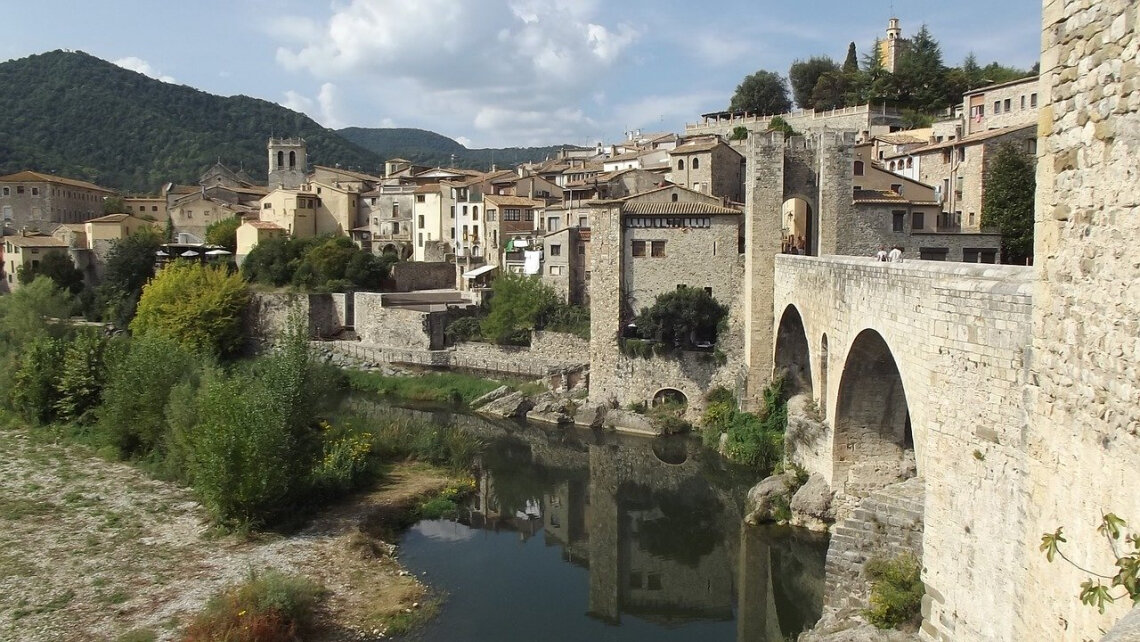
Monells

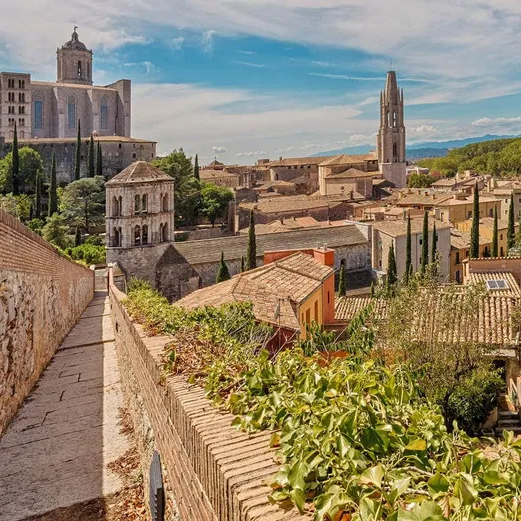
Monells is a very small town but with a very rich cultural past. Located in the Baix Empordà region, the village was built around the Castle of the Viscounts of Bas, a place that was much frequented by knights, nobles and merchants in medieval times.
The Plaza de Jaime I is one of the most charming spots. To reach it you must cross a gate that belongs to the old wall.
Although for iconic corners, the Church of San Genís. A very popular place for tourists visiting the municipality due to its mixture of architectural styles.
A visit of just over half a day with which you will feel as if you have taken a trip back in time.
Peratallada

Peratallada, also in the Baix Empordà, has an architectural heritage that will leave you speechless. It still maintains the essence of the medieval period and even preserves the structure of the time.
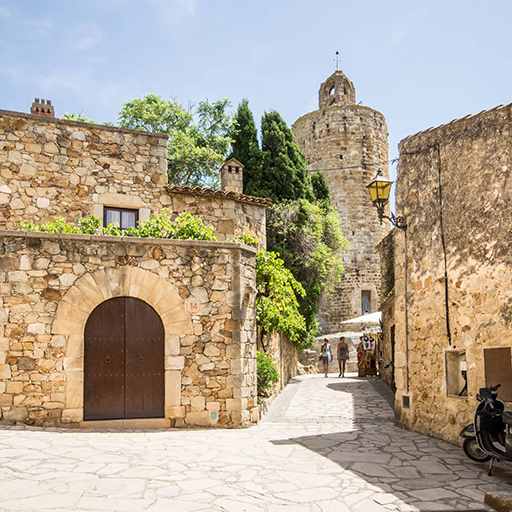
The entrance to the village is a real spectacle. You will have to leave your car in one of the outside car parks, since the whole village is walled and the circulation of vehicles is forbidden. When you enter you must pass under an arch, the protagonist of many photographs. The streets are long and narrow, all made of stone, so you will never forget that you are in front of a medieval village.
Right in the centre of the village is the Plaza de les Voltes: the main square of the village. There you will find several restaurants and terraces where you can spend a summer night or eat an ice cream. There are also small shops where you can buy some souvenirs of the area.
In Peratallada it is compulsory to visit the Church of Sant Esteve and the 11th century Castle-Palace, of which the Homage Tower, a true emblem of the town, stands out.
Pals

Perhaps one of the most visited villages in the Baix Empordà. And not without reason.
Pals is a town with a historic centre that makes it unique in the area. Moreover, it is very close to the Montgrí Natural Park, so the surrounding landscape is, if possible, even more spectacular.
From all the corners to visit, we highlight the Tower of the Hours, which belongs to a castle that was destroyed during the Catalan Civil War.
We also find the House-Museum of Ca la Pruna, a replica of an 18th century pharmacy where you can find exhibitions of Catalan wines and cavas and visit the Museum of Archaeology.
And don't leave without visiting the Church of Sant Pere: a beautiful combination of Romanesque, Baroque and even Gothic architecture.
In Pals you will also find the Josep Pla Viewpoint, the ideal place for photographing wonderful views from the Medes Islands to the Canigó.
After walking the Camino de Ronda from Pals to Begur, where you can discover some of the best beaches on the Costa Brava, go and have a drink in the Plaza Mayor in Pals. Enjoy the essence of the old part of the town with a moment of relaxation and good Empordà gastronomy.
Castelló d'Empúries

Castelló d'Empúries maintains both the structure and the medieval essence in the heart of the Alt Empordà. It is as if it had remained stagnant in time: its historical centre is full of memories of the ancient counts of Empúries, who decided to make this town the capital of their county.
One of the most important places in the municipality is the Portal de la Gallarda, one of the eight entrances that used to be there. All of them are located in different points of the old wall that surrounded Castelló.
Castelló d'Empúries is well known for the Basilica of Santa Maria, considered the Second Cathedral of Girona. It is a place with a lot of heritage, both artistic and cultural, which holds several treasures of history. If you have the opportunity, do not hesitate to enter and pay a visit to this temple.
Another place with a lot of history is the Rec del Molí, a water channel that carries water from the moat of the medieval wall to the Farinera de Castelló. The canal is currently used to irrigate the surrounding fields, generate energy and is also used for drinking water.
La Farinera is another corner you must visit. Full of secrets and curiosities of the time, you will discover how flour was made in the past and even medieval machinery has been preserved.
If you walk through its streets, you will find the Curia-prison, converted into a museum of curiosities about prison life, its rules and medieval justice.
In Castelló d'Empúries the Festival Terra de Trobadors is celebrated, set in the medieval period, and in which a medieval market is held and the whole town becomes a stage of the period full of activities and shows.
Madremanya

Madremanya is another small village in the Baix Empordà where you should also leave your car outside.
Madremanya is pure tranquillity, even though it is very close to major tourist destinations. From its entrance you can see the parish church of Sant Esteve, dated 994. Just in front of the church you will find another medieval building, the Portal de la Sagrera, from the 14th century.
The structure of the village still preserves the medieval origins of the time and many houses still have medieval decorative architectural elements.
Walking the streets of Madremanya is unique. The streets are narrow and long, and when you least expect it, you appear in one of its photogenic squares.
A very curious place is the Font Picant. It is said that the water from the fountain has medicinal properties and it was even made into a bottling plant in the 19th century, although the project had to be abandoned during the Civil War.
Come and visit the architectural complex belonging to the Lords of Millàs. It consists of the Church of Sant Iscle and Santa Victoria de Millàs, the Castle of Millàs and the Cross of Millàs. Please note that the Castle is private property and therefore its interior cannot be visited. Madremanya is the ideal place to disconnect from the big cities and take some time to relax among its medieval charms.
Begur

Segur is a town well known among tourists in the Baix Empordà for its beaches and dreamy coves. But also for its medieval history.
The watchtowers were built in the 16th century with the aim of protecting the town from the pirates who came to the town and are still standing today.
The medieval castle is also a must see. Although you can get there by car, we recommend that you do so on foot from the centre of the village. Enjoy a walk through the narrow streets and discover corners that combine old stone houses with brightly coloured facades.
There are currently only a few remains of its ancient wall, from which you can enjoy (and photograph) the best views of the Costa Brava.
The footpath that links Begur and Pals is an easy and almost compulsory route on foot. You will discover a great variety of coves and some of the best beaches in the province of Girona.
Sant Martí d’Empúries

Belonging to the municipality of l'Escala, Sant Martí d'Empúries is a small village located in the Alt Empordà. You may have heard the name of this municipality from the famous ruins of Empúries, a Greco-Roman site that can be visited and where you will discover a past full of history.
But Sant Martí is much more than that. In fact, it was the seat of the county of Empúries and a good part of the medieval wall is still preserved.
Walking around Sant Martí is very easy: all the streets lead to the Plaza Mayor. It is the perfect place to eat or drink something and, next to it, we can find the remains of Sant Martí Castle, considered Architectural Heritage of Catalonia.
If you visit Sant Martí with time, take the opportunity to walk along the promenade that links the town with l'Escala. You will discover the beaches and enjoy the views of the Bay of Roses.
Palau-Sator

The municipality of Palau-Sator is a group of small towns: Palau-Sator, Fontclara, Sant Julià de Boada and Sant Feliu de Boada, and Pantaleu. Each of them has a special charm but something very common: they all preserve the medieval essence of the period.
The most touristic place of Palau-Sator is its wall and its two entrances. The Tower of the Hours is the best preserved to date. It was part of the old castle and on its façade we can read the legend: "Només compto les hores serenes" (I only tell the serene hours). The castle, declared a cultural asset of national interest, can be visited outside the walls.
The Mas Pou Rural Museum is located in Palau-Sator. A very peculiar museum that focuses on the tools that were used in ancient agriculture, where you will discover how this activity has evolved in the area.
Its essential monuments, such as the Parish Church of Sant Pere, the Monastery of Sant Pau de Santa Clara and the Churches of Sant Feliu and Sant Julià de Boada, are in different areas. Don't miss any of them! They are perfect for a complete visit to this medieval village.
Peralada

Peralada, located in the Alt Empordà, a medieval village with winemaking origins.
Although it is well known for its golf courses and casino, the main icon is the castle, with its two towers and its photogenic vine. The gardens are beautiful and while you walk around them, you will not be able to avoid taking some pictures of their corners.
The visit is even more special in the summer months, when the Peralada International Music Festival is held.
Please note that the castle is currently a private property and cannot be visited in its entirety.
Right next door is the Convent of El Carme, built in the 14th century, which houses one of the most important art collections in Catalonia.
Don't forget to visit the Sant Domènec Cultural Centre, located in the Sant Domènec Cloister, a 13th century monument with capitals decorated with biblical and profane scenes as protagonists.