The 3 best rated Natural Parks in Alt Empordà
Parc Natural dels Aiguamolls de l'Empordà
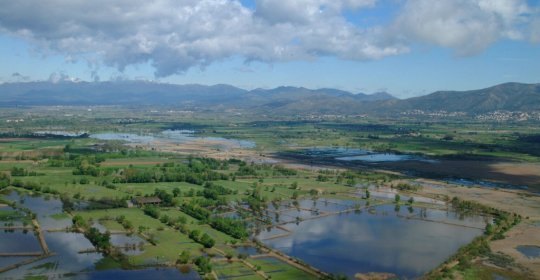
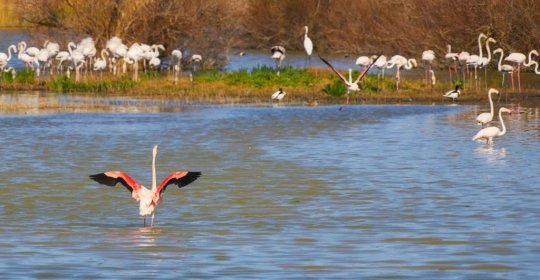
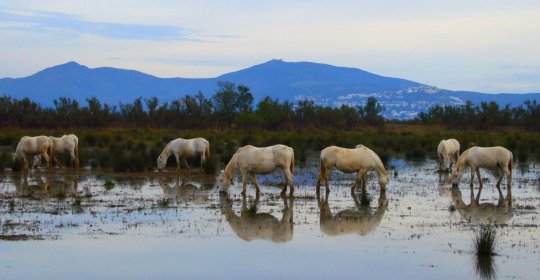
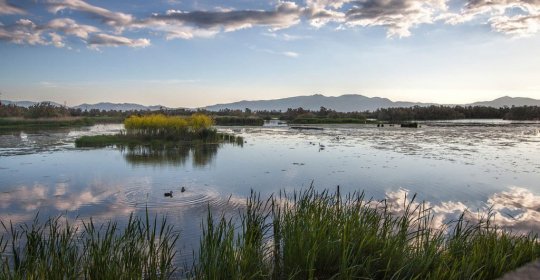
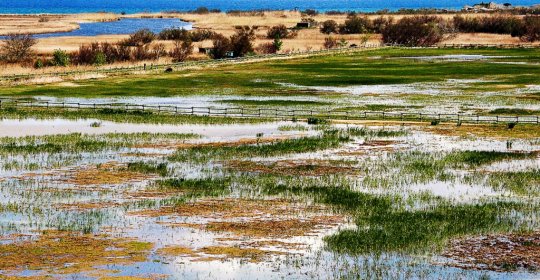
Of all the Natural Parks on the Costa Brava, without a doubt one of the most important nationally and internationally is the one known as Aiguamolls de l’Empordà.
In Empordà there are two rivers known as Muga and Fluvià. Between these two river spaces lies a wetland that was inaugurated in 1983 and is visited annually by many people.
This is a completely natural space that is protected. The Aiguamolls de l’Empordà Natural Park covers an area of more than four thousand seven hundred hectares. That is why it encompasses a total of nine different municipalities: Sant Pere Pescador, Roses, Perelada, Pedret i Marzà, Pau, Palau-saverdera, L’Escala, L’Armentera and Castelló d’Empúries.
Ecosystems
One of the most remarkable aspects of this Natural Park is the wide variety of ecosystems present. First of all, we must talk about the one that usually attracts the most attention from visitors: the marshland formed by fresh water.
Castelló d’Empúries used to have a lake. Its remains can be seen in the Aiguamolls de l’Empordà. Being in a more inland area, a considerable distance from the sea, the waters of these lagoons do not have the salinity of the coast.
Continuing with the marshland, both the fresh water and the depth allow the vegetation that can be admired in this place to have little in common with that of other areas of the Costa Brava, which is a result not only of the lower salinity but also of the high percentage of humidity.
As the years went by, the Aiguamolls de l’Empordà themselves promoted projects aimed at recovering lagoons whose condition was not desirable, as well as creating some completely new ones, always respecting the nature of the place as much as possible.
Having previously talked about the sea, we cannot overlook this other ecosystem that also attracts a lot of attention from those who visit the Natural Park. Right in front of the protected natural space is a coastal area that stands out for perfectly combining fine sand with sand that has a certain thickness.
Of course, there are also spectacular beaches in the Aiguamolls de l’Empordà. Basically, this is due to their being completely virgin. There are no others on the Costa Brava, and the main objective of the Natural Park is to continue preserving the virginity of these areas.
Precisely behind these virgin beaches are the well-known llaunes. Specifically, they are lagoons filled with vegetation that the locals call salsura. Both reeds and tiny streams have a strong presence in this ecosystem.
In the Aiguamolls de l’Empordà Natural Park, it is common to see a farmhouse or two, as well as certain constructions that fit in perfectly without detracting from the landscape. In fact, both the wild flora and the animals appreciate their presence, as they use these structures as refuges.
On the other hand, we cannot overlook the numerous crops that are in the protected space. They were different in the past and today are mainly trees that produce all kinds of fruits, as well as corn and sunflowers. In this regard, it is noteworthy that, since 1983, a specific crop has gradually been recovered: rice, which is very typical of this area of Empordà.
At the same time, disregarding the rivers mentioned earlier, another hydrographic aspect is noteworthy that forms an ecosystem full not only of ditches but also of dry riverbeds that differ greatly from one another. This is why botany lovers are amazed to see the vegetation present there, with the fauna also astonishing those who visit this place.
The last ecosystem is the marshes: meadows that can usually be seen in Empordà, and in this case, during the period of incessant rains, they become flooded, creating an unforgettable landscape. Some of the trees found there are poplars and ashes.
Itineraries
Due to the large number of ecosystems present, as well as the vast area covered, there are numerous itineraries to choose from. The ones you will see next are ordered based on the total length.
Mig de dos Rius
The first itinerary spans a kilometer and a half, so it can be completed in a short time. It is ideal for those visitors who have an hour or even less to enjoy the Natural Park. To complete it, one must pass on the left side of one of the rivers: Fluvià, just before the mouth.
The most surprising thing about Mig de dos Rius is undoubtedly the vegetation. It is impossible not to be amazed by the beauty exuded by the orchids, as well as the other plant elements present both in the meadow and in the forest.
As expected, this is also an itinerary enjoyed by those who love to watch hard-to-see wildlife, a prime example being the black and yellow bird known as the oriole.
Vilaüt
Now that we have talked about birds, it is a good time to mention the one that became the first observatory for this type of animal to open in all of Catalonia. It was created in the same year that the Natural Park opened: 1983.
This observatory can be seen on an itinerary that can be done both on foot and by bicycle, although in the latter case it is advisable to go as slowly as possible to make the experience last.
The best time to do the Vilaüt itinerary is spring. During this time of year, a huge amount of colorful flowers can be seen, welcoming visitors with a spectacle of shades: from the yellows of the lilies to the pinks and oranges of the buttercups. Additionally, between May and June, it is possible to see how some birds that are not easy to spot arrive at the site.
From Mas del Matà to the lagoons
This itinerary can be done by people with mobility difficulties, as it is wheelchair accessible. It is also possible to complete it while pushing a baby stroller.
The route starts at Cortalet and is two thousand three hundred meters long. It is an ideal route for those who want to make several stops, as there are many observatories where visitors can enjoy observing both the local wildlife and flora.
From Cortalet to the Estanques Europa
If you want to take a slightly longer route, one of the recommended itineraries for hikers and cyclists is this one at four kilometers. Although it is enjoyable all year round, it is noteworthy that there is a lack of tall vegetation, hence there is no shade. For this reason, in case you do it during the summer, sunscreen is essential.
The route passes through a spot that tends to make all visitors take out their phones and cameras to capture unforgettable photos: the bridge of Empuriabrava that crosses over the Muga river, offering spectacular views.
Natural Itinerary of Fluvià
We finish with two itineraries that are recommended mainly for cycling enthusiasts, as the distance to be covered is significant, especially for the last itinerary. In this case, we are talking about a total of almost nine kilometers.
In Sant Pere Pescador, there is a center that informs visitors, which is precisely where the route begins. Following the Fluvià, specifically on the right side of the river, one arrives at the beautiful mouth, as well as at some dunes that allow for a beautiful beach view.
What surprises those who dare to undertake this itinerary the most is the diversity of environments along the eight thousand six hundred meters.
Route of the Lagoons
The list of itineraries ends with another that must be done by bike. It spans over thirty kilometers in total, starting and ending at Cortalet, as it is a circular route.
After starting the exit, one arrives at Vilaüt, passing through all kinds of fields where multiple foods are grown, forests full of vegetation, marshes with a high level of humidity, and ultimately, scenery that differs significantly from one another.
The Route of the Lagoons is by far the most varied route of all. In fact, it is even possible to see a couple of very old hermitages, with Sant Antoni attracting the most attention, although Sant Joan dels Erms also exudes great charm, especially because of its location.
How to get there
It is not difficult to reach the Aiguamolls de l’Empordà Natural Park, regardless of the means you choose: bus, train, or private transport.
Bus
You must go to Castelló d’Empúries, a town that receives buses coming from Figueres. From the medieval municipality, it is possible to take another bus that has a stop precisely at the protected space you intend to visit.
Train
The line connecting Barcelona to Portbou is the one to take, getting off at the Figueres station, which connects to the bus, then you must follow the plan previously described to go from this city to Castelló and reach the Aiguamolls de l’Empordà.
Private vehicle
Whether you go by car or prefer a motorcycle or any other private vehicle, you must drive on the AP-7 highway towards La Jonquera, a border town with France. Exit at Figueres Sud (4), while if you are coming from the opposite direction you will need to exit at Figueres Nord (3).
Follow the route to Roses and, passing through the A-2, you will reach the C-260. When it becomes a highway, count the roundabouts, as at the fifth there is an exit that indicates a key town's name: Sant Pere Pescador. Take this exit leading to the Aiguamolls de l’Empordà, also marked on the same sign.
After traveling approximately three kilometers, you can turn left to start a short route that will take you to Cortalet.
Rates
It is free to enjoy the more than three hundred bird species that are constantly changing due to migrations, as well as the dunes, ponds, and other attractions that the Aiguamolls de l’Empordà Natural Park has to offer.
Where to park
If you want to park right at El Cortalet, where many itineraries begin, you will have to pay a fee of five euros.
If you prefer not to pay for parking, there is another parking lot at Mas Matà that can be used to leave your private vehicle at no cost.
Paratge Natural d'Interès Nacional de l'Albera
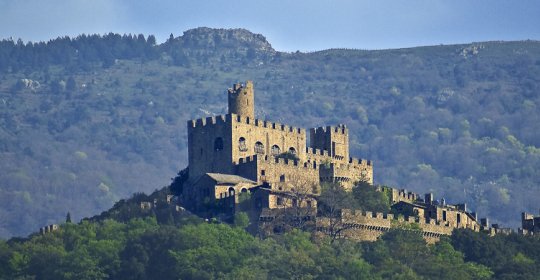
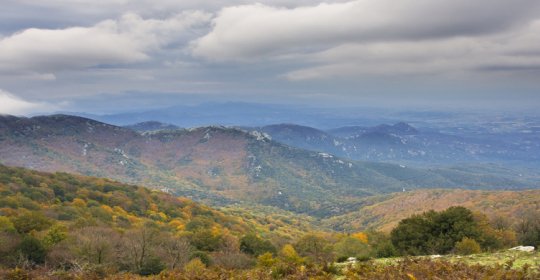
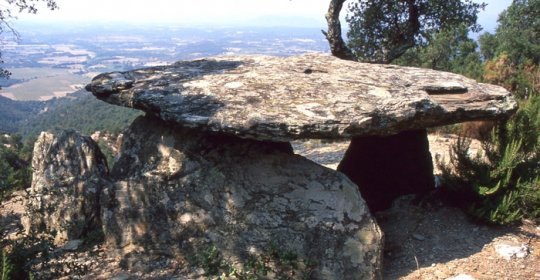
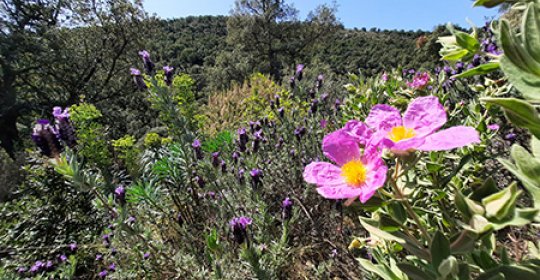
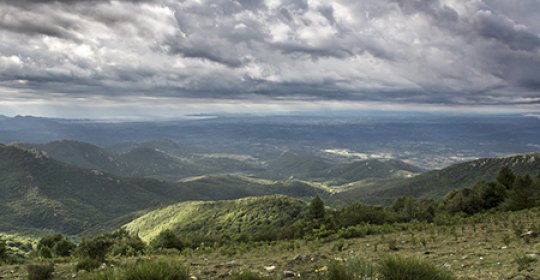
On the Costa Brava, there is an area that was designated as a natural monument in 1986: the Sierra de la Albera, a site of national interest that covers an area of over four thousand two hundred hectares.
The large expanse of this space is evident with the total number of municipalities it encompasses. Specifically, there are three: Rabós, Espolla, and La Junquera. Thus, it is very close to the French border.
In El Pertús, a small French village, there is a port. Right there begins the part of the Pyrenees that belongs to the Sierra de la Albera, ending at the Costa Brava.
We are talking about one of the most important mountain ranges in Catalonia, especially because of the large number of peaks it has, which have a considerable elevation. The record goes to Puig Neulós, reaching a total of 1,257 meters.
Throughout its 25km length, it is possible to see numerous attractions, distributed across a couple of partial nature reserves. The smallest one, despite covering an area of 395 hectares, is located by a river known as Orlina, and the main objective of this area is to protect both the oak forests and the many beech trees present in the area.
The other partial nature reserve initially had 580 hectares, but it expanded by a hundred more just a year after being declared a natural site of national interest. Unlike the first, the vegetation is secondary here to focus protection mainly on one particular animal: the turtle that is often seen in the Mediterranean.
Fauna
Now that we have mentioned this turtle, it is a good time to delve deeper into the fauna present in the National Natural Area of La Albera. Before describing the others, it is worth emphasizing these herpetological beings, as there are no populations of such animals in the rest of the Iberian Peninsula. Therefore, it is not surprising that everything possible is done to protect them.
They are not the only species present in this place that is synonymous with pure nature. Those belonging to herpetology are also common, especially frogs, and one must add to the list a multitude of lizards and even snakes.
Setting aside reptiles and amphibians, the countless birds that populate the National Natural Area of La Albera cannot be overlooked. Specifically, the number of species far exceeds a total of two hundred, so it is possible to sight new and very different birds from each other every day.
After discussing birds, it is now time for fish. They are abundant, especially the ones that attract attention for their large sizes: mountain barbs. Trout, for their part, can also be spotted in this place.
Finally, mammals constitute an important part of the fauna of the natural monument. The number of species reaches 44, leading to only 25 percent of the mammals found throughout Catalonia not being seen in the Sierra de la Albera.
Of all the mammals that coexist in the national site of interest, undoubtedly the most important is the Albera cow. It is not surprising that it receives this name, as it is endemic to the area. In fact, we are dealing with semi-wild animals, of which there are approximately only four hundred globally.
Flora
If animals are very important for the National Natural Area of La Albera, the vegetation elements that also have a notable presence in the area are no less so.
The San Quirico de Colera-Balmeta area is typical of the Mediterranean in general, as evidenced not only by its scrubland but also by the cork oak forests. Unfortunately, it is an area that tends to be hit by fires, which take a heavy toll on the natural monument.
The other sector presents a flora very different from the one just mentioned. We are talking about Requesens-Baussitges, being vegetation with a higher humidity level and with characteristics that have little to do with those of the other flora, mainly due to elevation. In this case, we talk about beech trees, holm oaks, oak woods, and chestnuts. To top it off, at many peaks, one can appreciate the beautiful alpine meadows that are common in mountain ranges.
This list of flora does not end here. In fact, the flora typical of riverbanks is present near the river named Anyet. There are numerous alders, as well as willows and ashes.
Must-see sites
If you decide to visit the National Natural Area of La Albera, you will have several itineraries to choose from, which we will describe later. Regardless of your choice, do not miss a series of points of great interest, which for one reason or another are very attractive.
Castle of Requesens
This mountain range is not only the perfect definition of nature. It also has constructions that are well worth it, a clear example being the castle of Requesens that was built in medieval times. A couple of centuries ago it was remodeled, based on a style that evokes romanticism.
If you find yourself in the plain, you will be able to perfectly see this structure, which is located specifically on the hill of a valley very close to one of the rivers that flow through the natural monument: the Anyet.
Romanesque structures
Continuing with the structures, some of the most imposing are the Romanesque ones. All of them boast a good state of preservation, which is particularly commendable considering the many years they have behind them.
Both on the northern and southern slopes, there are various hermitages that stand out for their simplicity, as well as for how beautiful they are. Simplicity in construction does not apply when discussing the most notable Romanesque structure of all: a monastery for Benedictines located in Sant Quirze de Colera.
In this secluded valley, a great dose of tranquility can be felt, making it ideal for disconnecting and completely escaping stress. There is a church with a beautiful basilica, as well as remnants of what was once a cloister.
Monuments thousands of years old
Some of the monuments that still exist today in the southern part of the National Natural Area of La Albera are over five thousand years old. Those with the most presence are the dolmens, surpassing a total of one hundred and fifty.
Menhirs and sculptures are not far behind. The point that attracts most visitors' attention is Mas Baleta, as there is a circle of megaliths in that area that surprises with its good condition.
Pools
To fully enjoy the experience of visiting this natural monument, one must admire its pools. Unfortunately, this can only be done in a specific season: spring, although if lucky, there may also be some possibilities at other times of the year. It all depends on the rainfall, as these beautiful pools form when it rains abundantly.
During the months when they are filled with water, both the fauna and flora of the national site change completely, as elements that adapt perfectly to the environment with a very high humidity percentage arise.
Stone Beech
Many plant elements gain special relevance, although most visitors specifically aim for one named Stone Beech.
Basically, it is an arbre that, over time, has become somewhat of a monument. Additionally, there is a lot of other vegetation worth a special mention nearby, especially the sorbs and the flags.
Viewpoint
Throughout the National Natural Area of La Albera, there are numerous points that offer privileged views, but if you want to enjoy what are considered to be the best of all the viewpoint of Puig Neulós is a must-visit.
Thanks to its great height of over one thousand two hundred fifty meters, the skyline is spectacular in every sense. No matter which direction you look, you will be amazed, able to admire plains belonging to l'Empordà, the Bay of Roses -considered one of the most beautiful in all of Europe-, a Natural Reserve known as Bosc de la Maçana, etc.
Itineraries
The National Natural Area of La Albera is one of the most versatile and varied natural parks on the Costa Brava. The various itineraries available are a testament to this.
From Cantallops to Requesens
It is not a long itinerary, as it covers just over five kilometers. Thus, hikers complete it in a couple of hours. Also, the total elevation gain is just over three hundred fifty meters, making it a linear route that is not particularly difficult, although it is not suitable for people with no physical fitness or mobility issues.
The itinerary begins in Cantallops and, through a sort of pilgrimage path, leads to an iconic church named Santa Maria de Requesens. Heading north, one reaches a trail that allows crossing a stream, which is known as Les Comtes, taking just a quarter of an hour.
Half an hour after starting the route, you will notice the first dolmens located in Medàs. By traversing another trail on the left, you will reach Font de les Feixes, which directly connects to Requesens.
Itinerary around the castle
Unlike the previous itinerary, this route is suitable for almost anyone, as it is very easy to cover the five and a half kilometers it comprises.
The elevation gain reaches only about one hundred forty meters, and it can be completed in just under two hours. It is a circular route that starts from a parking area, specifically from Pipes.
After passing Font Rovellada, the path begins to circle around the Castle of Requesens, continuing through Can Picardia and then Corral Nou. Shortly thereafter, you arrive at a shelter and a tile factory.
Throughout the route, many of the resources that the mountains formerly provided to those who engaged in economic activities there are evident. Specifically, this refers to water and wood. The latter material was used as fuel to operate multiple kilns.
Stone Beech Route
The second longest itinerary of all goes past one of the must-see visits we previously mentioned: the legendary tree called Stone Beech.
The route begins at the parking lot of the tile factory and is circular, covering nine kilometers over a total duration of three hours. The elevation gain accumulates up to four hundred meters, making this medium difficulty itinerary.
The route passes through key points such as Roc de les Cabres, Font del Faig, and Pont de les Cultives. It is worth noting the existence of a shortcut that can be found half an hour into the journey, leading up towards Puig Neulós. By taking it, you will save a couple of kilometers, but if you want to fully enjoy the experience, it is better to follow the source of Els Arcaires, which connects to a bridge.
Excursion through the Requesens forests
At the same parking lot where the previous route begins, there is an itinerary that is not suitable for all hikers. This is a route that presents a series of difficulties and, moreover, is quite long: totaling 11 kilometers.
The circular route features an accumulated elevation gain of over four hundred thirty meters, but the truth is that it is well worth it if you enjoy flora in general. Throughout the five hours, you will be amazed at all the vegetation found in the mountain's forests.
After passing through Requesens and beginning a path towards Puig Neulós, it's time to take a shortcut leading to a key destination: Faig de la Pedra. The next elements you will encounter along the way are a couple of fountains - Els Arcaires and Nova -, Roc de l’Atalaiador, and a stream: Coll Pregon.
Upon reaching the river lock belonging to the river Anyet, you will have the option to initiate the itinerary around the castle or, on the contrary, start the path that will take you back to the parking lot of the tile factory.
Rules
Regardless of which itinerary you choose, there are a series of rules that must be strictly followed. The first concerns pets, especially dogs, which are often seen in the National Natural Area of La Albera alongside their owners. It is permissible to take them hiking, but they cannot be unleashed: a leash is mandatory.
Furthermore, camping freely in any of the areas that comprise the natural monument is not allowed. No fires may be lit either, as it is an area with a high risk of wildfire.
If any type of waste or garbage is generated, it must not be left in the mountain, each person must take it away so that no trace remains.
Again referring to the itineraries, it should be noted that during the course of them, it is common to encounter private properties, which must be respected.
Finally, both the culture and nature of the site must not be altered in the slightest, whether by damaging plants, uprooting them, or causing any disturbance to an animal.
Rates
As is the case with the vast majority of natural parks in the Costa Brava, visiting it is free and completely without charge.
Parc Natural del Cap de Creus
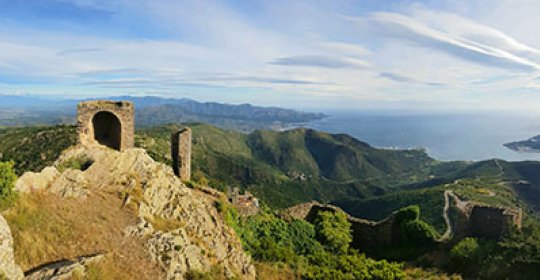
In March 1998, an area of the Costa Brava was officially created that belongs to the sixth category of the International Union for Conservation of Nature. This is the Cap de Creus Natural Park, a protected area with a quite large surface area, reaching almost fourteen thousand hectares in total.
Before the existence of the Cap de Creus Natural Park, there was no other marine-terrestrial park in the Autonomous Community of Catalonia. Specifically, of the entire area covered, 900 hectares are terrestrial nature reserves, while 835 are also organic reserves, but in this case of marine type.
The protected area is framed within eight different municipalities, all belonging to the Costa Brava. Port de la Selva, Cadaqués, Roses, and Llansá are some of the most known at the national level, and should add to the list Pau, Vilajuiga, Palau Sabardera, and Selva de Mar.
Flora
In some natural parks of the Costa Brava, we are used to seeing a type of purely Mediterranean flora. However, in Cap de Creus there is an enormous variety, including central European, eurosiberian, and even Atlantic plant elements.
This is why at the Cap de Creus Natural Park it is possible to see from many shrubs and cork oaks that are very typical of the Mediterranean to other types of flora that are not usually seen: siliceous mountain meadows, hazelnuts, and a long etcetera.
The tramuntana wind that usually blows in this protected area exerts a modeling of each plant species that is present there, hardening the habitat due to various purely organic aspects. The first of these can be summarized as the fact that plants evapotranspire more. On the other hand, their salinity level is higher, being this aspect a result of the aerosols given by the seawater.
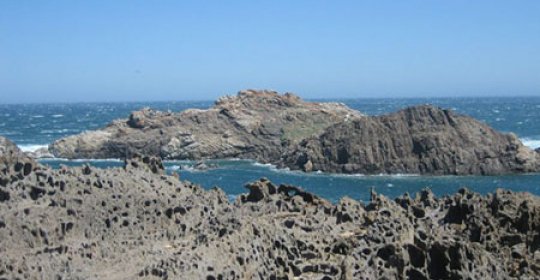
Although rock has a huge presence in the Cap de Creus Natural Park, either in the form of rocky areas or even cliffs with beautiful views of the sea, in certain areas there is a beautiful outcrop that forms a visual spectacle full of many colors.
Fauna
The type of fauna that abounds most in this natural park of the Costa Brava is undoubtedly amphibians. Although not all those species found in the Iberian Peninsula are seen in Cap de Creus, a very high percentage makes an appearance in this protected area. Common toads are very common, as is the southern frog, which draws attention due to its small size.
Following the example of the Paratge Natural d’Interès Nacional de l’Albera, the Mediterranean turtle can also be seen in Cap de Creus, although in this case the quantity is much more reduced. Other similar animals are part of the list, highlighting among them the leprous tortoise, the common gecko, and the ocellated lizard.
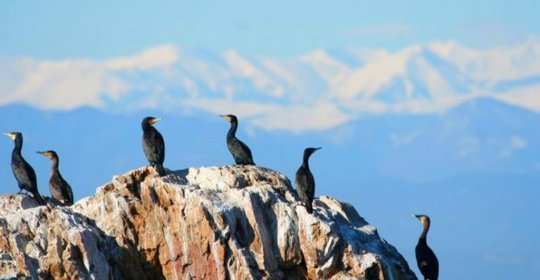
Another type of fauna that is also very important for the ecosystem of this natural park is the one that flies over. When birds migrate both in the autumn and spring seasons, it is highly recommended to visit the Cap de Creus Natural Park, as many species can be seen.
Just going to any cliff is enough to see several Bonelli's eagles, although they are not the only birds that tend to roam these rocky areas that this fauna likes. The list is added with owls, peregrine falcons, and so forth.
Of course, the marine environment fully affects the fauna, leading to the presence of everything from birds to many fish in the water's depths. Starting with flying animals, seagulls are extremely common in Cap de Creus, while other birds are not so present in the protected area: gannets, terns, shearwaters, and the shag, among many others.
Next, we need to talk about the fauna of the marine bottom. What stands out to those who have the privilege of observing it is the reddish coral, which is shared by the gorgonian scientifically named paramuricea clavata.
There are numerous fish that roam the waters of the Cap de Creus Natural Park, prominently featuring many grouper, bream, and sardines. They coexist harmoniously with lobsters and lobsters.
Rules
Enjoying both the flora and fauna, as well as the itineraries we will describe later, requires complying with a series of rules, which vary depending on whether access is to the terrestrial or marine area.
If you opt for the terrestrial area, you should know that you need a specific authorization to plant any type of plant element, as well as to extract it. On the other hand, no type of waste can be thrown.
Going through the terrestrial area is possible if you do not move with a motor vehicle, although it can be done on the tracks designated for this purpose, as well as on the roads.
Camping is not allowed freely in any of the areas, while in some of them fire is permitted, provided that the stipulated periods for doing so are respected.
Concluding with the rules that reference the terrestrial area of the Cap de Creus Natural Park, it is noteworthy that there is a possibility of hunting, having to strictly apply the relevant regulations.
If you choose to go to one of the integral nature reserves that are part of this protected area, you must circulate according to the itinerary that you intend to follow, so completely free movement is not allowed. At the same time, extracting any plant or animal element is completely prohibited, as well as any fossils, rocks, or mineral sets that are present in the natural park.
Beyond the terrestrial, there are also partial marine nature reserves. In them, the regulations must be applied when practicing fishing, visiting the area, anchoring, diving, or moving through the area via the maritime route.
The marine area that is not a partial nature reserve is also subject to important rules, such as that certain specific fishing methods are prohibited: purse seine and trawling. On the contrary, if it is artisanal or carried out as if it were a sport, fishing can be practiced.
Itineraries
In the Cap de Creus Natural Park, there are several itineraries, so each visitor can choose the one that suits them best. However, all of them are a bit difficult. Unlike other natural parks in the Costa Brava that have very simple routes, being such an abrupt area steep slopes and very narrow passages are common. This is why comfortable and good quality footwear is essential, regardless of whether the itineraries are undertaken by adults or children.
Circular itinerary to the Punta del Cap de Creus
This route is ideal for enjoying the wonderful landscapes that the area offers to hikers. It is a circular itinerary that covers just over one and a half kilometers, with some sections being a bit difficult.
Punta de Cap de Creus, Cova de S’Infern, and S’Eixugador are some of the places visited during the ninety-minute duration, starting the experience at the lighthouse.
To follow the circular itinerary, reddish signs must be followed. The herbaceous plant reed and the reeds are very present, especially at the end of the route.
Cala Culip
Two kilometers are enough to reach an iconic cove in the Costa Brava, which, unlike many others, tends to be little frequented by bathers. This is due to the difficult access, which is only compatible with hiking tours or maritime crossings.
From the Cap de Creus Natural Park, you only need to travel two kilometers, which takes about three-quarters of an hour. The itinerary is not too difficult, ending at a cove that is only fifteen meters long. It is worth noting that nudism is allowed on the beach.
Old path from the lighthouse to Cadaqués
If you want to explore the natural park with family, this route suitable for the little ones is the best possible choice, although it is long due to its considerable distance: eight kilometers in total.
Steep slopes are hardly present in the itinerary. This is why it is quite common to encounter other families.
How to get there
The AP-7 connects with several regional roads that lead to various municipalities of the Costa Brava, one of the most beautiful being the well-known Cadaqués, a lovely fishing village. This town is precisely the one to reach to start the journey to the Cap de Creus Natural Park.
In Cadaqués, there are many signs, so it is not difficult to reach the iconic lighthouse that begins itineraries that provide a unique experience. However, it is not a drive suitable for all types of people, as those who get overly dizzy with curves or are not used to driving on very winding roads may end up having a hard time.
However, if that's not the case, it is a route that is fully enjoyed. In fact, it is one of the best routes to take by private vehicle, as during the journey spectacular views unfold.
Where to park
After reaching the end of the winding road that takes you from Cadaqués to the Cap de Creus lighthouse, you will find a parking area that is quite spacious, as well as free, which is appreciated. However, it is not easy to find an empty space, especially in the middle of the summer season. If you decide to visit this protected area in July or August, it is advisable to go early if you want to park easily right at the lighthouse.
Fees
Following the example of the parking area, the unforgettable experience of touring the Cap de Creus Natural Park is completely free.