Places to stay in Garrotxa
Zona Volcánica de la Garrotxa
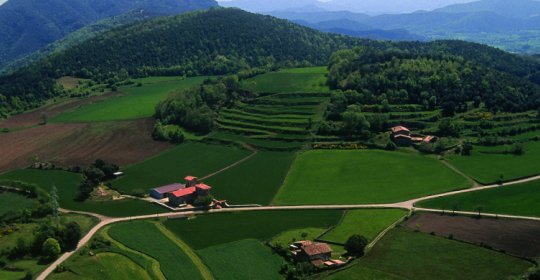
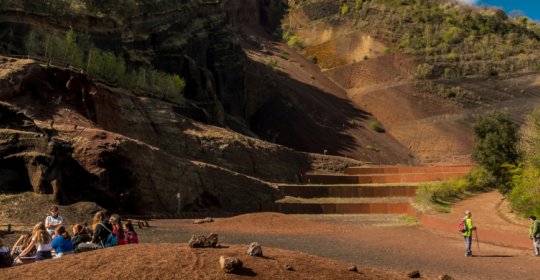
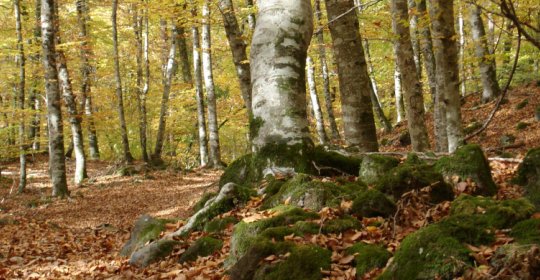
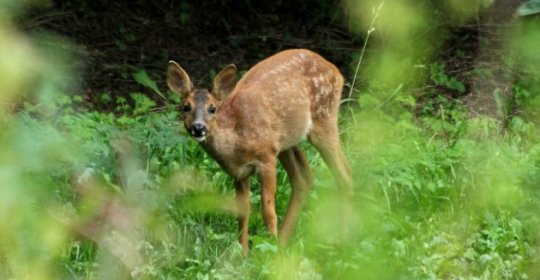
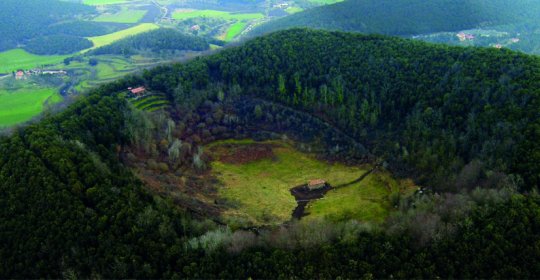
In the Iberian Peninsula there are several volcanic landscapes, although none is as beautiful and extensive as this protected space located on the Costa Brava. We are talking about the Volcanic Zone of Garrotxa, which was reclassified in 1985. At that time it was determined that the area became a natural park.
Its surface exceeds fifteen thousand hectares, encompassing a total of eleven municipalities including Olot, Las Planas, and Castellfullit de la Roca. On the other hand, the natural reserves are nearly thirty.
The Volcanic Zone of Garrotxa comprises forty volcanic-type cones whose origin dates back more than one hundred thousand years, being a clear example of the great historical and biological value they all have.
Furthermore, this natural park of the Costa Brava has around ten craters, as well as more than twenty cones that boast of being in good conservation status. Additionally, the numerous lava flows with their dark color and microlitic texture reveal that they are of basaltic type.
Volcanoes
While it is true that some volcanoes in the protected area are only ten thousand years old, others originated seven hundred thousand years ago. Volcanic activity has not occurred for a long time, although that does not mean that all the volcanoes are extinct. But, how is it possible that there is such volcanism in this area of the Costa Brava? Basically, this is due to the finesse of the lithosphere.
In Garrotxa, this outer layer does not have the more than one hundred kilometers that characterize the European continent, but its thickness is only fifteen kilometers. This additionally led to each eruption occurring in a recently emerged volcano, which proceeded to extinguish just after without having any further activity.
The morphology of each volcanic cone is very varied. The craters demonstrate this perfectly, as some are lateral, while others are central and have pyroclasts that stand out for their uniformity, some of them being heterometric.
In one of the areas of the Volcanic Zone of Garrotxa there are many small stones known as lapillis, which were expelled during several eruptions.
Experts estimate that when a minimum of ten thousand more years have passed, there will be an eruption in this protected space again.
Flora
Although the volcanoes are the main attraction of the Volcanic Zone of Garrotxa, both the flora and fauna are also fully enjoyable. Starting with vegetation, it is notable that the number of plant species widely exceeds one thousand in total.
Thanks to the elevations of the terrain, the type of soil, and the climatic conditions, it cannot be said that the scenic result is purely Mediterranean, since part of it resembles what can be seen in Central Europe.
One of the areas that most attracts attention is known under the name of Fageda d’en Jordà. It basically consists of a forest full of beeches that have managed to grow despite being at an altitude of five hundred fifty meters. This is due to how humid this part of the protected space is and the extent to which volcanic-origin rock drains.
The forests are lush and numerous in the Volcanic Zone of Garrotxa, especially highlighting cork oaks, holm oaks, and oaks.
Fauna
The variety is evident when talking not only about the flora, but also about the fauna. The animals most present in the protected area are undoubtedly invertebrates, although vertebrates also play an important role, as demonstrated by the total of over three hundred different species.
The most numerous species are the birds, widely exceeding two hundred. For their part, mammals are also important for the Volcanic Zone of Garrotxa. Among the animals that can be frequently seen are the following: wild cats, genets, peregrine falcons, vipers, and snake eagles.
Economic activity
It is common for natural parks on the Costa Brava to have virtually no human presence, beyond those in charge of ensuring the well-being of the area and the visitors. However, this is not the case with this protected space. In fact, an economic activity occurs daily in it, carried out while trying to respect the area's nature.
Specifically, we are referring to crops known as garrotxes, taking advantage of the useful terraces in areas where the relief is quite steep. Another economic activity is the extraction of lapilli, which is used to manufacture cement.
It is surprising that only two percent of the Volcanic Zone of Garrotxa is public, with the remaining percentage being completely private, part of which is used for activities related to economic development. Thus, the administrators of the protected space have the main objective of ensuring that all of them are compatible with the well-being of the natural park.
Itineraries
In this natural park of the Costa Brava there are many attractions worth visiting. Volcanoes such as those of Santa Margarida and Croscat are a clear example, as well as the Fluvià River, wetlands, etc. All of them can be traversed on itineraries that are very varied, allowing people of all ages, regardless of their physical ability, to undertake a route that they enjoy from start to finish.
Fageda d’en Jordà, Volcà de Santa Margarida and Volcà del Croscat
We begin with Itinerary 1, one of the most practiced by visitors. This is not surprising considering that during its course three points of great interest are covered.
This is a circular route that connects with other itineraries in the Volcanic Zone of Garrotxa that are also highly recommended. After one and a half hours it reaches Sant Miquel de Sacot, while after almost ten kilometers of route there is a shortcut that is recommended to take: the one of Can Passavent.
After about four and a half hours the itinerary is considered complete, although the time increases if you choose to descend into the crater, as it covers a total of seven hundred meters that require an additional twenty minutes of walking.
Riscal de Castellfollit de la Roca
If you love great views you cannot miss this itinerary. After just over a kilometer, you will reach a viewpoint that will reward your visit with a skyline that you will hardly forget.
Before that, you will pass through the cliff, and then visit the Plaça de Sant Roc. The itinerary can be completed in just three-quarters of an hour, being suitable for the elderly and small children, as it has no considerable elevation changes.
Volcà del Montsacopa
In the Volcanic Zone of Garrotxa, there are several iconic volcanoes, one of the most attractive being the one known as Montsacopa. This itinerary that passes through Montolivet and Tossols makes it possible to explore it.
We are facing one of the most varied routes, as it also has a strong urban character. This is due to covering a large part of the city of Olot, whose streets are traversed, with locals being the ones who usually undertake this itinerary.
Upon reaching the Montsacopa volcano, the first thing that surprises is its considerable height of almost one hundred meters, as well as the crater's diameter, reaching one hundred twenty meters in total.
Valls de Sant Iscle and del Vallac
Itinerary 19 is one of the most physically demanding of all those that can be done in the Volcanic Zone of Garrotxa. For some people, it is not easy to cover the total of seventeen kilometers that it encompasses. However, if you feel capable of it, the five hours of the trail will be enjoyed to the fullest.
The route starts at what used to be the Sant Feliu de Pallerols station. After two hours and a quarter, you arrive at Sant Iscle de Colltort, shortly after reaching an iconic volcano known as Can Tià. This is not the only one visited in the itinerary, as another must be added to the list: that of Traiter.
Being a circular itinerary, it ends at the same station, making it hard to get lost thanks to the indications based on pictograms with a light orange color.
How to get there
The most recommended way is to travel by private or public transport to Olot, although you can also choose Santa Pau. In both cases, the AP-7 connects with local roads that will take you to either municipality, where there is a bus you have to take. This is the Bus dels Volcans, which will take you directly to the Volcanic Zone of Garrotxa.
Where to park
If you prefer to avoid the bus and choose to go directly to the natural park with your own vehicle, you should know that there are a couple of parking lots, although they charge fees. The Can Serra parking is one of the most frequented, as it is near the Fageda d’en Jordà. However, keep in mind that payment cannot be made in cash.
On the other hand, the parking lot at the Santa Margarida Area does not accept cards. Getting to it is easy by taking the local road GI-524, appreciating the proximity to one of the most iconic volcanoes in the protected area.
Rates
Except for guided tours organized by some companies, traversing the Volcanic Zone of Garrotxa is free. The amount collected from vehicles parked in the two previously described parking lots is used to keep some parts of this natural park in the Costa Brava in good condition.