Places to stay in Espolla
Paratge Natural d'Interès Nacional de l'Albera
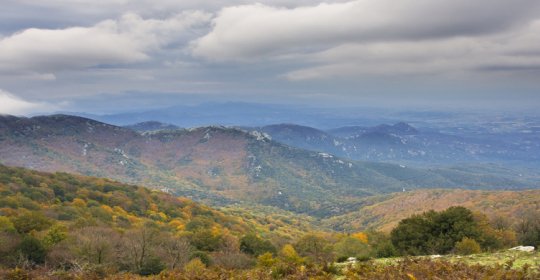
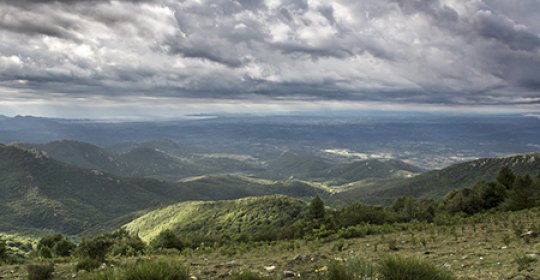
On the Costa Brava, there is an area that was designated as a natural monument in 1986: the Sierra de la Albera, a site of national interest that covers an area of over four thousand two hundred hectares.
The large expanse of this space is evident with the total number of municipalities it encompasses. Specifically, there are three: Rabós, Espolla, and La Junquera. Thus, it is very close to the French border.
In El Pertús, a small French village, there is a port. Right there begins the part of the Pyrenees that belongs to the Sierra de la Albera, ending at the Costa Brava.
We are talking about one of the most important mountain ranges in Catalonia, especially because of the large number of peaks it has, which have a considerable elevation. The record goes to Puig Neulós, reaching a total of 1,257 meters.
Throughout its 25km length, it is possible to see numerous attractions, distributed across a couple of partial nature reserves. The smallest one, despite covering an area of 395 hectares, is located by a river known as Orlina, and the main objective of this area is to protect both the oak forests and the many beech trees present in the area.
The other partial nature reserve initially had 580 hectares, but it expanded by a hundred more just a year after being declared a natural site of national interest. Unlike the first, the vegetation is secondary here to focus protection mainly on one particular animal: the turtle that is often seen in the Mediterranean.
Fauna
Now that we have mentioned this turtle, it is a good time to delve deeper into the fauna present in the National Natural Area of La Albera. Before describing the others, it is worth emphasizing these herpetological beings, as there are no populations of such animals in the rest of the Iberian Peninsula. Therefore, it is not surprising that everything possible is done to protect them.
They are not the only species present in this place that is synonymous with pure nature. Those belonging to herpetology are also common, especially frogs, and one must add to the list a multitude of lizards and even snakes.
Setting aside reptiles and amphibians, the countless birds that populate the National Natural Area of La Albera cannot be overlooked. Specifically, the number of species far exceeds a total of two hundred, so it is possible to sight new and very different birds from each other every day.
After discussing birds, it is now time for fish. They are abundant, especially the ones that attract attention for their large sizes: mountain barbs. Trout, for their part, can also be spotted in this place.
Finally, mammals constitute an important part of the fauna of the natural monument. The number of species reaches 44, leading to only 25 percent of the mammals found throughout Catalonia not being seen in the Sierra de la Albera.
Of all the mammals that coexist in the national site of interest, undoubtedly the most important is the Albera cow. It is not surprising that it receives this name, as it is endemic to the area. In fact, we are dealing with semi-wild animals, of which there are approximately only four hundred globally.
Flora
If animals are very important for the National Natural Area of La Albera, the vegetation elements that also have a notable presence in the area are no less so.
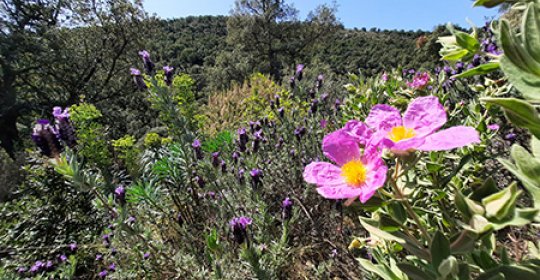
The San Quirico de Colera-Balmeta area is typical of the Mediterranean in general, as evidenced not only by its scrubland but also by the cork oak forests. Unfortunately, it is an area that tends to be hit by fires, which take a heavy toll on the natural monument.
The other sector presents a flora very different from the one just mentioned. We are talking about Requesens-Baussitges, being vegetation with a higher humidity level and with characteristics that have little to do with those of the other flora, mainly due to elevation. In this case, we talk about beech trees, holm oaks, oak woods, and chestnuts. To top it off, at many peaks, one can appreciate the beautiful alpine meadows that are common in mountain ranges.
This list of flora does not end here. In fact, the flora typical of riverbanks is present near the river named Anyet. There are numerous alders, as well as willows and ashes.
Must-see sites
If you decide to visit the National Natural Area of La Albera, you will have several itineraries to choose from, which we will describe later. Regardless of your choice, do not miss a series of points of great interest, which for one reason or another are very attractive.
Castle of Requesens
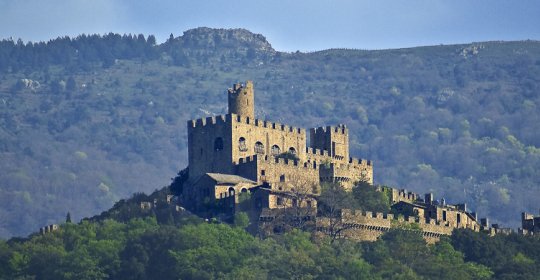
This mountain range is not only the perfect definition of nature. It also has constructions that are well worth it, a clear example being the castle of Requesens that was built in medieval times. A couple of centuries ago it was remodeled, based on a style that evokes romanticism.
If you find yourself in the plain, you will be able to perfectly see this structure, which is located specifically on the hill of a valley very close to one of the rivers that flow through the natural monument: the Anyet.
Romanesque structures
Continuing with the structures, some of the most imposing are the Romanesque ones. All of them boast a good state of preservation, which is particularly commendable considering the many years they have behind them.
Both on the northern and southern slopes, there are various hermitages that stand out for their simplicity, as well as for how beautiful they are. Simplicity in construction does not apply when discussing the most notable Romanesque structure of all: a monastery for Benedictines located in Sant Quirze de Colera.
In this secluded valley, a great dose of tranquility can be felt, making it ideal for disconnecting and completely escaping stress. There is a church with a beautiful basilica, as well as remnants of what was once a cloister.
Monuments thousands of years old
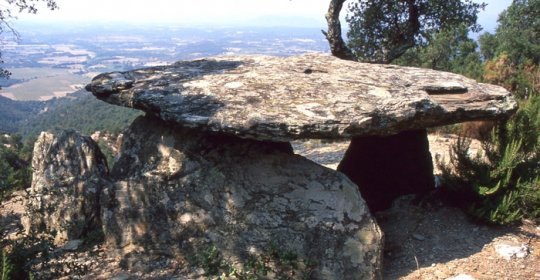
Some of the monuments that still exist today in the southern part of the National Natural Area of La Albera are over five thousand years old. Those with the most presence are the dolmens, surpassing a total of one hundred and fifty.
Menhirs and sculptures are not far behind. The point that attracts most visitors' attention is Mas Baleta, as there is a circle of megaliths in that area that surprises with its good condition.
Pools
To fully enjoy the experience of visiting this natural monument, one must admire its pools. Unfortunately, this can only be done in a specific season: spring, although if lucky, there may also be some possibilities at other times of the year. It all depends on the rainfall, as these beautiful pools form when it rains abundantly.
During the months when they are filled with water, both the fauna and flora of the national site change completely, as elements that adapt perfectly to the environment with a very high humidity percentage arise.
Stone Beech
Many plant elements gain special relevance, although most visitors specifically aim for one named Stone Beech.
Basically, it is an arbre that, over time, has become somewhat of a monument. Additionally, there is a lot of other vegetation worth a special mention nearby, especially the sorbs and the flags.
Viewpoint
Throughout the National Natural Area of La Albera, there are numerous points that offer privileged views, but if you want to enjoy what are considered to be the best of all the viewpoint of Puig Neulós is a must-visit.
Thanks to its great height of over one thousand two hundred fifty meters, the skyline is spectacular in every sense. No matter which direction you look, you will be amazed, able to admire plains belonging to l'Empordà, the Bay of Roses -considered one of the most beautiful in all of Europe-, a Natural Reserve known as Bosc de la Maçana, etc.
Itineraries
The National Natural Area of La Albera is one of the most versatile and varied natural parks on the Costa Brava. The various itineraries available are a testament to this.
From Cantallops to Requesens
It is not a long itinerary, as it covers just over five kilometers. Thus, hikers complete it in a couple of hours. Also, the total elevation gain is just over three hundred fifty meters, making it a linear route that is not particularly difficult, although it is not suitable for people with no physical fitness or mobility issues.
The itinerary begins in Cantallops and, through a sort of pilgrimage path, leads to an iconic church named Santa Maria de Requesens. Heading north, one reaches a trail that allows crossing a stream, which is known as Les Comtes, taking just a quarter of an hour.
Half an hour after starting the route, you will notice the first dolmens located in Medàs. By traversing another trail on the left, you will reach Font de les Feixes, which directly connects to Requesens.
Itinerary around the castle
Unlike the previous itinerary, this route is suitable for almost anyone, as it is very easy to cover the five and a half kilometers it comprises.
The elevation gain reaches only about one hundred forty meters, and it can be completed in just under two hours. It is a circular route that starts from a parking area, specifically from Pipes.
After passing Font Rovellada, the path begins to circle around the Castle of Requesens, continuing through Can Picardia and then Corral Nou. Shortly thereafter, you arrive at a shelter and a tile factory.
Throughout the route, many of the resources that the mountains formerly provided to those who engaged in economic activities there are evident. Specifically, this refers to water and wood. The latter material was used as fuel to operate multiple kilns.
Stone Beech Route
The second longest itinerary of all goes past one of the must-see visits we previously mentioned: the legendary tree called Stone Beech.
The route begins at the parking lot of the tile factory and is circular, covering nine kilometers over a total duration of three hours. The elevation gain accumulates up to four hundred meters, making this medium difficulty itinerary.
The route passes through key points such as Roc de les Cabres, Font del Faig, and Pont de les Cultives. It is worth noting the existence of a shortcut that can be found half an hour into the journey, leading up towards Puig Neulós. By taking it, you will save a couple of kilometers, but if you want to fully enjoy the experience, it is better to follow the source of Els Arcaires, which connects to a bridge.
Excursion through the Requesens forests
At the same parking lot where the previous route begins, there is an itinerary that is not suitable for all hikers. This is a route that presents a series of difficulties and, moreover, is quite long: totaling 11 kilometers.
The circular route features an accumulated elevation gain of over four hundred thirty meters, but the truth is that it is well worth it if you enjoy flora in general. Throughout the five hours, you will be amazed at all the vegetation found in the mountain's forests.
After passing through Requesens and beginning a path towards Puig Neulós, it's time to take a shortcut leading to a key destination: Faig de la Pedra. The next elements you will encounter along the way are a couple of fountains - Els Arcaires and Nova -, Roc de l’Atalaiador, and a stream: Coll Pregon.
Upon reaching the river lock belonging to the river Anyet, you will have the option to initiate the itinerary around the castle or, on the contrary, start the path that will take you back to the parking lot of the tile factory.
Rules
Regardless of which itinerary you choose, there are a series of rules that must be strictly followed. The first concerns pets, especially dogs, which are often seen in the National Natural Area of La Albera alongside their owners. It is permissible to take them hiking, but they cannot be unleashed: a leash is mandatory.
Furthermore, camping freely in any of the areas that comprise the natural monument is not allowed. No fires may be lit either, as it is an area with a high risk of wildfire.
If any type of waste or garbage is generated, it must not be left in the mountain, each person must take it away so that no trace remains.
Again referring to the itineraries, it should be noted that during the course of them, it is common to encounter private properties, which must be respected.
Finally, both the culture and nature of the site must not be altered in the slightest, whether by damaging plants, uprooting them, or causing any disturbance to an animal.
Rates
As is the case with the vast majority of natural parks in the Costa Brava, visiting it is free and completely without charge.