The best rated Natural Parks in Castelló d'Empúries
Parc Natural dels Aiguamolls de l'Empordà
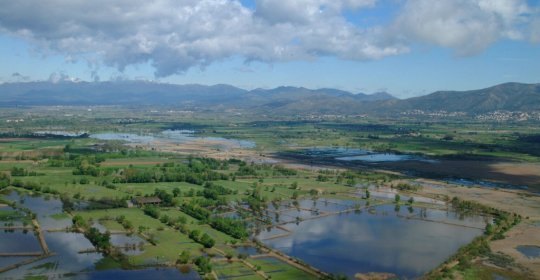
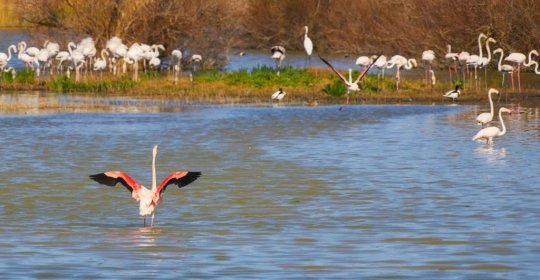
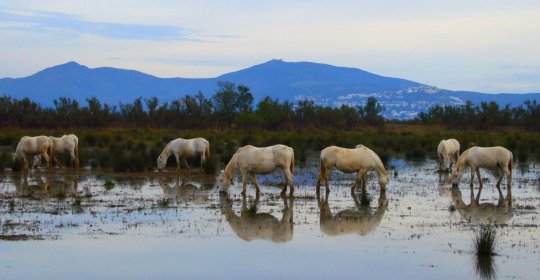
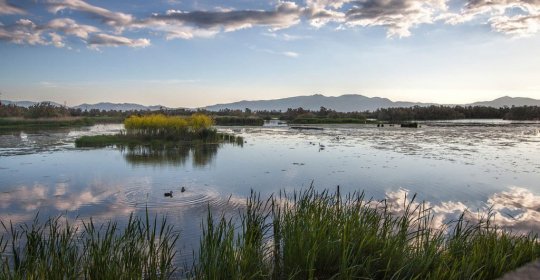
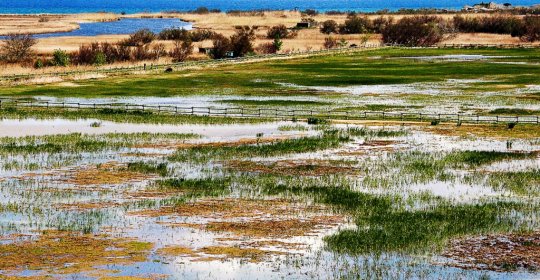
Of all the Natural Parks on the Costa Brava, without a doubt one of the most important nationally and internationally is the one known as Aiguamolls de l’Empordà.
In Empordà there are two rivers known as Muga and Fluvià. Between these two river spaces lies a wetland that was inaugurated in 1983 and is visited annually by many people.
This is a completely natural space that is protected. The Aiguamolls de l’Empordà Natural Park covers an area of more than four thousand seven hundred hectares. That is why it encompasses a total of nine different municipalities: Sant Pere Pescador, Roses, Perelada, Pedret i Marzà, Pau, Palau-saverdera, L’Escala, L’Armentera and Castelló d’Empúries.
Ecosystems
One of the most remarkable aspects of this Natural Park is the wide variety of ecosystems present. First of all, we must talk about the one that usually attracts the most attention from visitors: the marshland formed by fresh water.
Castelló d’Empúries used to have a lake. Its remains can be seen in the Aiguamolls de l’Empordà. Being in a more inland area, a considerable distance from the sea, the waters of these lagoons do not have the salinity of the coast.
Continuing with the marshland, both the fresh water and the depth allow the vegetation that can be admired in this place to have little in common with that of other areas of the Costa Brava, which is a result not only of the lower salinity but also of the high percentage of humidity.
As the years went by, the Aiguamolls de l’Empordà themselves promoted projects aimed at recovering lagoons whose condition was not desirable, as well as creating some completely new ones, always respecting the nature of the place as much as possible.
Having previously talked about the sea, we cannot overlook this other ecosystem that also attracts a lot of attention from those who visit the Natural Park. Right in front of the protected natural space is a coastal area that stands out for perfectly combining fine sand with sand that has a certain thickness.
Of course, there are also spectacular beaches in the Aiguamolls de l’Empordà. Basically, this is due to their being completely virgin. There are no others on the Costa Brava, and the main objective of the Natural Park is to continue preserving the virginity of these areas.
Precisely behind these virgin beaches are the well-known llaunes. Specifically, they are lagoons filled with vegetation that the locals call salsura. Both reeds and tiny streams have a strong presence in this ecosystem.
In the Aiguamolls de l’Empordà Natural Park, it is common to see a farmhouse or two, as well as certain constructions that fit in perfectly without detracting from the landscape. In fact, both the wild flora and the animals appreciate their presence, as they use these structures as refuges.
On the other hand, we cannot overlook the numerous crops that are in the protected space. They were different in the past and today are mainly trees that produce all kinds of fruits, as well as corn and sunflowers. In this regard, it is noteworthy that, since 1983, a specific crop has gradually been recovered: rice, which is very typical of this area of Empordà.
At the same time, disregarding the rivers mentioned earlier, another hydrographic aspect is noteworthy that forms an ecosystem full not only of ditches but also of dry riverbeds that differ greatly from one another. This is why botany lovers are amazed to see the vegetation present there, with the fauna also astonishing those who visit this place.
The last ecosystem is the marshes: meadows that can usually be seen in Empordà, and in this case, during the period of incessant rains, they become flooded, creating an unforgettable landscape. Some of the trees found there are poplars and ashes.
Itineraries
Due to the large number of ecosystems present, as well as the vast area covered, there are numerous itineraries to choose from. The ones you will see next are ordered based on the total length.
Mig de dos Rius
The first itinerary spans a kilometer and a half, so it can be completed in a short time. It is ideal for those visitors who have an hour or even less to enjoy the Natural Park. To complete it, one must pass on the left side of one of the rivers: Fluvià, just before the mouth.
The most surprising thing about Mig de dos Rius is undoubtedly the vegetation. It is impossible not to be amazed by the beauty exuded by the orchids, as well as the other plant elements present both in the meadow and in the forest.
As expected, this is also an itinerary enjoyed by those who love to watch hard-to-see wildlife, a prime example being the black and yellow bird known as the oriole.
Vilaüt
Now that we have talked about birds, it is a good time to mention the one that became the first observatory for this type of animal to open in all of Catalonia. It was created in the same year that the Natural Park opened: 1983.
This observatory can be seen on an itinerary that can be done both on foot and by bicycle, although in the latter case it is advisable to go as slowly as possible to make the experience last.
The best time to do the Vilaüt itinerary is spring. During this time of year, a huge amount of colorful flowers can be seen, welcoming visitors with a spectacle of shades: from the yellows of the lilies to the pinks and oranges of the buttercups. Additionally, between May and June, it is possible to see how some birds that are not easy to spot arrive at the site.
From Mas del Matà to the lagoons
This itinerary can be done by people with mobility difficulties, as it is wheelchair accessible. It is also possible to complete it while pushing a baby stroller.
The route starts at Cortalet and is two thousand three hundred meters long. It is an ideal route for those who want to make several stops, as there are many observatories where visitors can enjoy observing both the local wildlife and flora.
From Cortalet to the Estanques Europa
If you want to take a slightly longer route, one of the recommended itineraries for hikers and cyclists is this one at four kilometers. Although it is enjoyable all year round, it is noteworthy that there is a lack of tall vegetation, hence there is no shade. For this reason, in case you do it during the summer, sunscreen is essential.
The route passes through a spot that tends to make all visitors take out their phones and cameras to capture unforgettable photos: the bridge of Empuriabrava that crosses over the Muga river, offering spectacular views.
Natural Itinerary of Fluvià
We finish with two itineraries that are recommended mainly for cycling enthusiasts, as the distance to be covered is significant, especially for the last itinerary. In this case, we are talking about a total of almost nine kilometers.
In Sant Pere Pescador, there is a center that informs visitors, which is precisely where the route begins. Following the Fluvià, specifically on the right side of the river, one arrives at the beautiful mouth, as well as at some dunes that allow for a beautiful beach view.
What surprises those who dare to undertake this itinerary the most is the diversity of environments along the eight thousand six hundred meters.
Route of the Lagoons
The list of itineraries ends with another that must be done by bike. It spans over thirty kilometers in total, starting and ending at Cortalet, as it is a circular route.
After starting the exit, one arrives at Vilaüt, passing through all kinds of fields where multiple foods are grown, forests full of vegetation, marshes with a high level of humidity, and ultimately, scenery that differs significantly from one another.
The Route of the Lagoons is by far the most varied route of all. In fact, it is even possible to see a couple of very old hermitages, with Sant Antoni attracting the most attention, although Sant Joan dels Erms also exudes great charm, especially because of its location.
How to get there
It is not difficult to reach the Aiguamolls de l’Empordà Natural Park, regardless of the means you choose: bus, train, or private transport.
Bus
You must go to Castelló d’Empúries, a town that receives buses coming from Figueres. From the medieval municipality, it is possible to take another bus that has a stop precisely at the protected space you intend to visit.
Train
The line connecting Barcelona to Portbou is the one to take, getting off at the Figueres station, which connects to the bus, then you must follow the plan previously described to go from this city to Castelló and reach the Aiguamolls de l’Empordà.
Private vehicle
Whether you go by car or prefer a motorcycle or any other private vehicle, you must drive on the AP-7 highway towards La Jonquera, a border town with France. Exit at Figueres Sud (4), while if you are coming from the opposite direction you will need to exit at Figueres Nord (3).
Follow the route to Roses and, passing through the A-2, you will reach the C-260. When it becomes a highway, count the roundabouts, as at the fifth there is an exit that indicates a key town's name: Sant Pere Pescador. Take this exit leading to the Aiguamolls de l’Empordà, also marked on the same sign.
After traveling approximately three kilometers, you can turn left to start a short route that will take you to Cortalet.
Rates
It is free to enjoy the more than three hundred bird species that are constantly changing due to migrations, as well as the dunes, ponds, and other attractions that the Aiguamolls de l’Empordà Natural Park has to offer.
Where to park
If you want to park right at El Cortalet, where many itineraries begin, you will have to pay a fee of five euros.
If you prefer not to pay for parking, there is another parking lot at Mas Matà that can be used to leave your private vehicle at no cost.
